01 · Case study
OpenGraph Creator
Create and edit social images from one reliable workflow.
The problem
Most AI image workflows end with a flattened file. That is quick, but it leaves the next person with no useful structure to edit, inspect, or reuse. A repository also needs more than a single image: it needs predictable paths, metadata wiring, export checks, and a workflow another agent can safely resume.
OpenGraph Creator treats the editable document as the product. The output image is only one artifact derived from it.
What I built
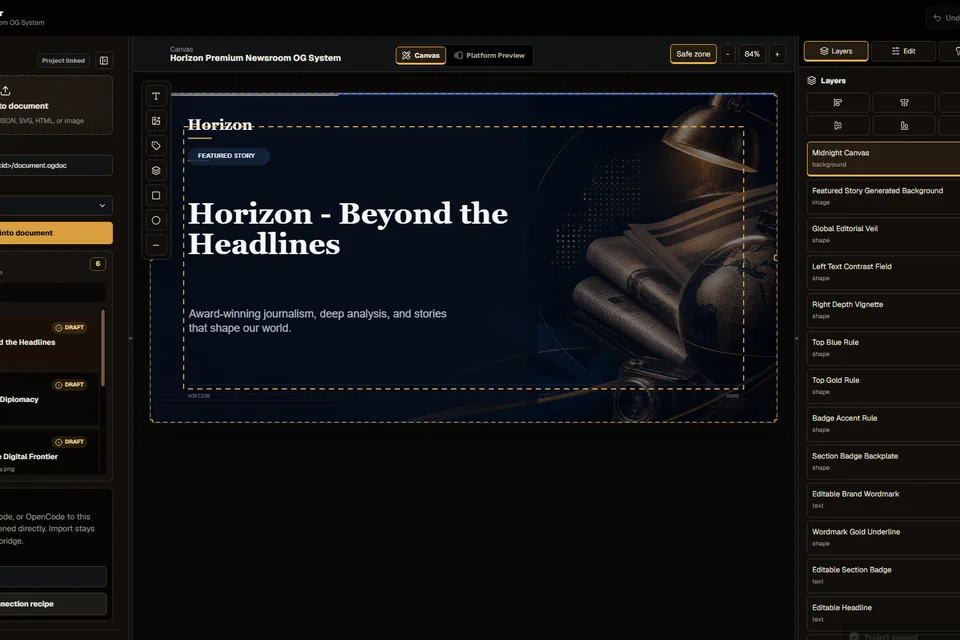
I designed a TypeScript monorepo containing a CLI runtime, a React/Vite Studio,
an .ogdoc document model, and an SVG-to-raster export pipeline. Coding agents
can inspect a repository, assemble a layered document, open it in Studio for
human adjustment, and continue from the same local session.
The supplied resume records four published packages and export support for PNG, WebP, and JPEG. The public repository also documents integrations for Codex, Claude Code, and OpenCode.
The important decision
The handoff between agent and editor is a file-and-session protocol rather than an opaque cloud conversation. That makes the workflow inspectable. A person can see what changed, recover a session, and keep the source document beside the code that uses it.
repository -> agent inspection -> layered .ogdoc -> Studio edit
          -> validated export -> metadata wiring -> resumable session
What I learned
Agent tooling becomes more useful when it leaves durable state behind. The most important interface was not a prompt box; it was the boundary between automated work and deliberate human control.